
 Image 1 of 1
-
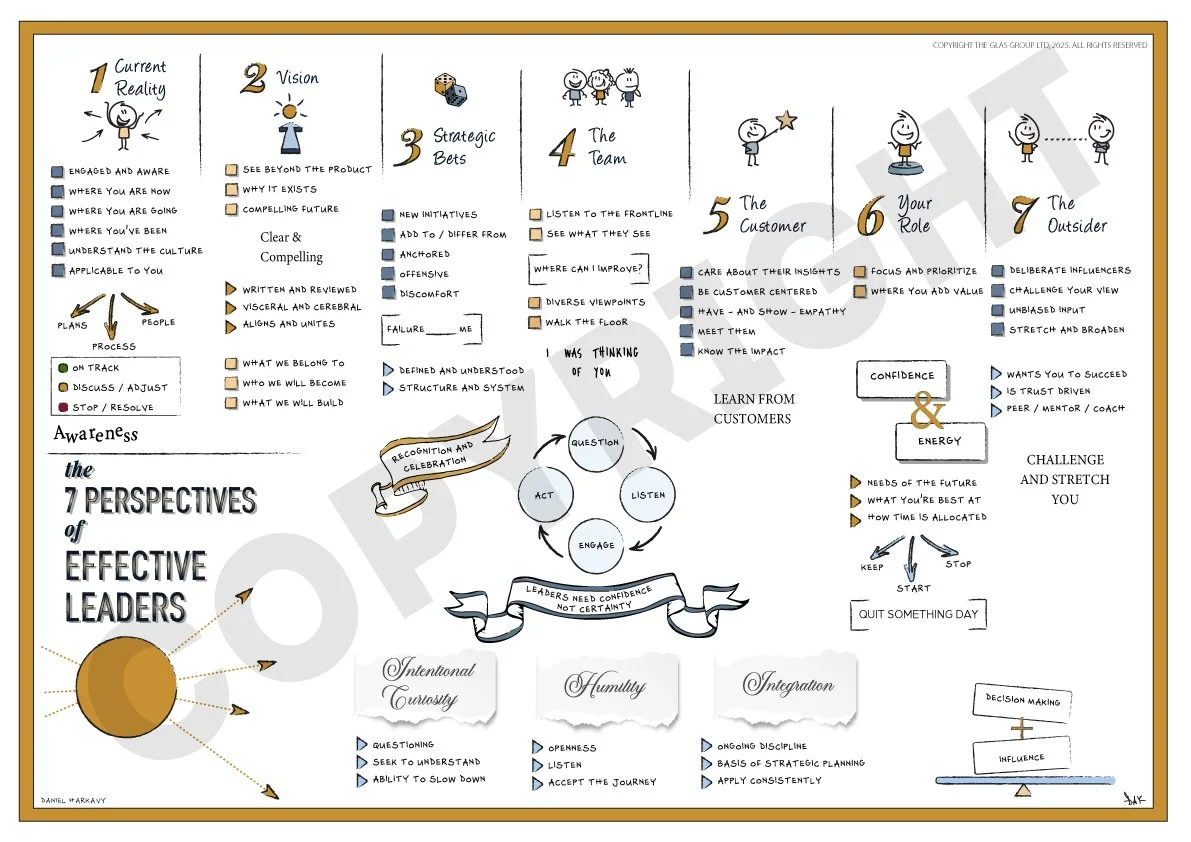
Viewed through the GLAS Method, Harkavy’s 7 perspectives are essentially alignment lenses that help leaders maintain balance across the 7 Elements by choosing frames of thinking that support coherence rather than drift. For example, the possibilities perspective aligns with Growth / Learning and Purpose / Meaning, enabling a leader to see beyond constraints and move toward aspiration. The awareness perspective directly supports Emotions / Awareness, the foundational element for noticing states of balance or misalignment.
Each perspective also helps guard against common drift states: defaulting to defensiveness disrupts energy and relationships, while a scarcity mindset inhibits joy and purpose. By shifting into perspectives like choice and responsibility, leaders reconnect intention and action, aligning behaviour with values rather than habitual reaction — a core GLAS principle. This internal realignment ripples outward, improving decision quality, relational dynamics, and resilience under pressure.
Functionally, the 7 perspectives act like a higher-level LEAPS meta‑cycle: they enable leaders to notice their cognitive frame, evaluate whether it serves alignment across elements, adjust to a more generative view, perform with greater intentionality, and then sustain balanced states over time. Rather than tactical tweaks, the book equips leaders with a mental architecture that supports coherence across purpose, energy, awareness, relationships, growth, environment, and joy.
-
-