
 Image 1 of 1
-
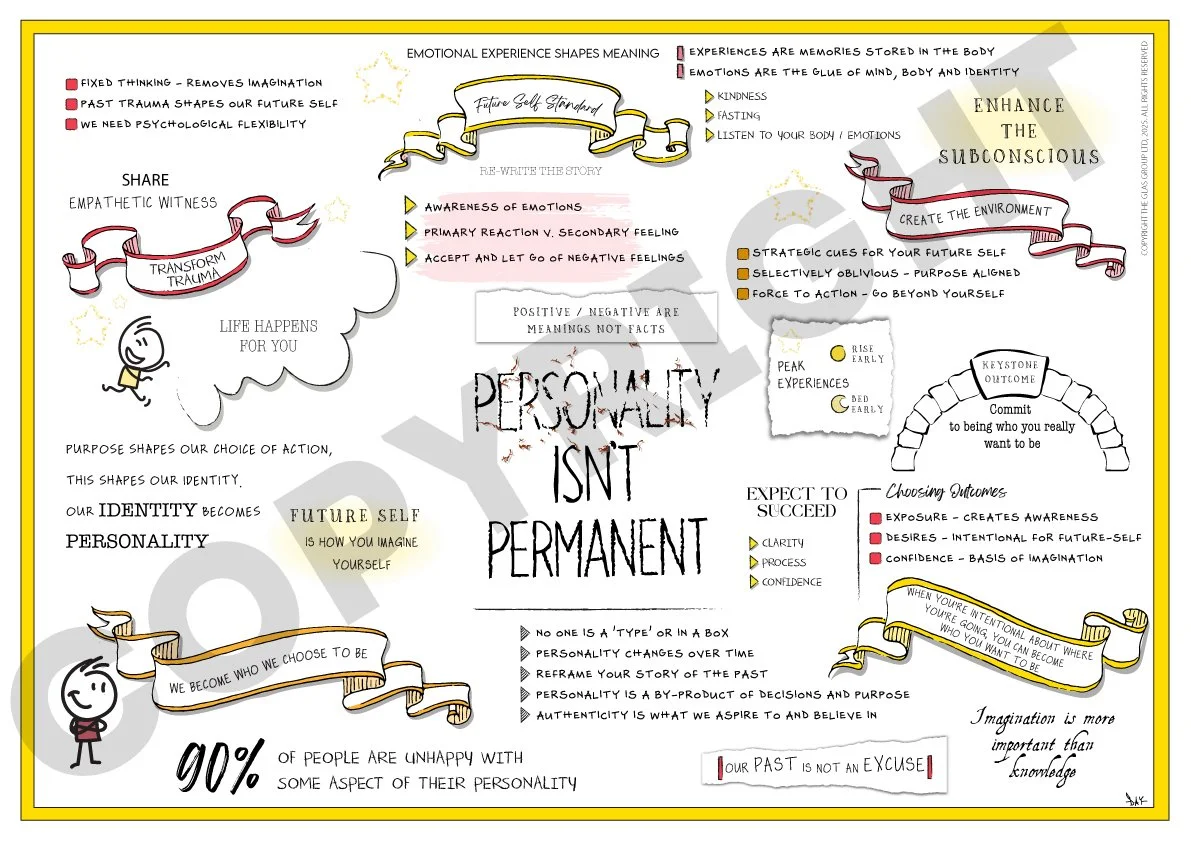
From a GLAS Method perspective, Personality Isn’t Permanent strengthens Growth / Learning, Purpose / Meaning, and Environment / Context by reframing personality as a design outcome, not a fixed constraint. This aligns closely with GLAS’s emphasis on deliberate self-awareness and intentional action; when people see personality as emergent, not predetermined, they become empowered to notice internal states and purposefully reshape habits and contexts that support aligned behaviour rather than drift.
Hardy’s future-self approach reinforces Purpose / Meaning, as it centers transformation around clear aspirations rather than reactive survival patterns. Clarifying who you want to become creates a north star that aligns decisions and behaviours across the system, reducing the internal conflict that arises when actions don’t match identity. In GLAS terms, this creates coherence between intention, action, and experience, strengthening sustainable alignment across elements.
The book’s emphasis on shaping environment and identity supports Emotions / Awareness and Energy / Vitality because internal states are better regulated when context is designed to reinforce desired behaviours. By choosing environments, cues, and social systems that support the future self, individuals reduce cognitive friction and preserve energy for meaningful growth. GLAS’s LEAPS process (Notice → Evaluate → Adapt → Perform → Sustain) naturally incorporates this, as future-focused design makes misalignment easier to identify and correct early.
-
-