
 Image 1 of 1
-
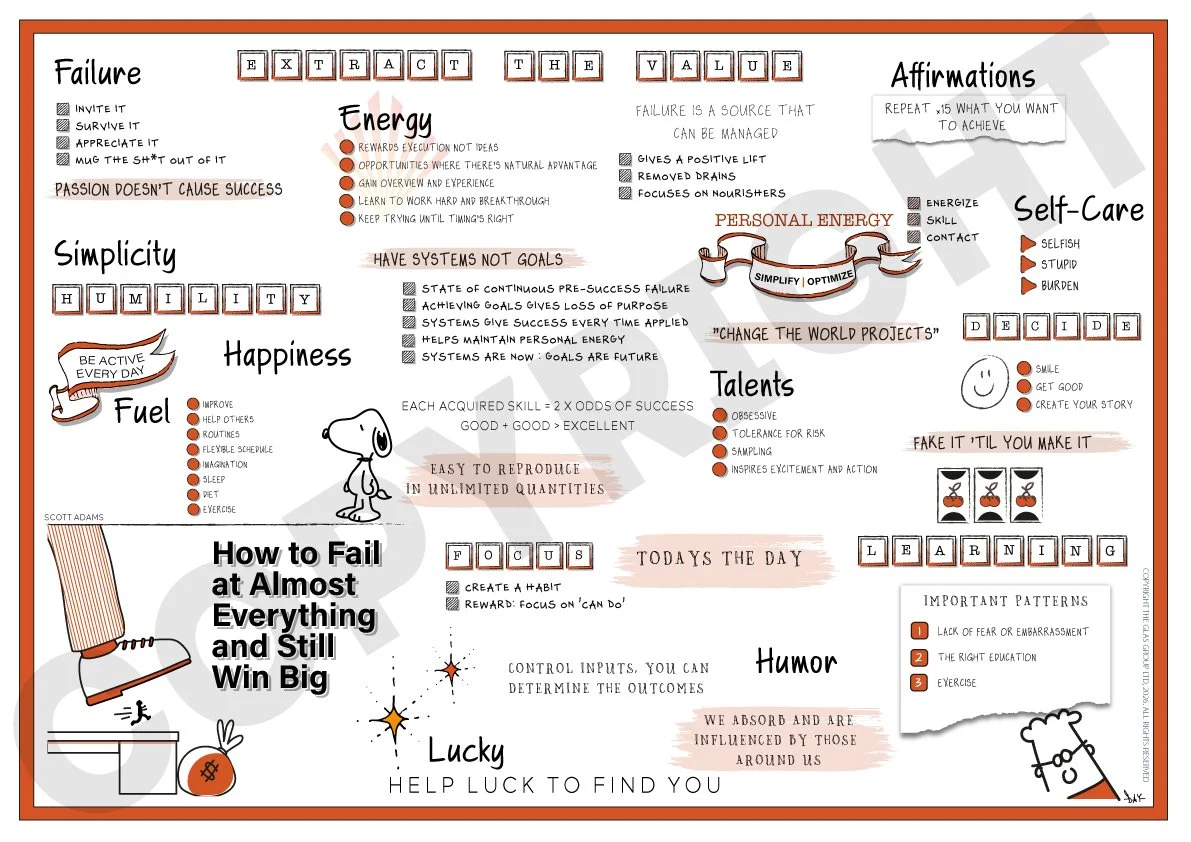
From the GLAS Method perspective, How to Fail at Almost Everything and Still Win Big intersects strongly with Energy / Vitality, Growth / Learning, and Environment / Context, because Adams reframes success as a product of systems that preserve energy, leverage diverse skills, and create conditions for repeated iteration rather than burning out in pursuit of rigid goals. His emphasis on managing energy aligns with GLAS’s prioritisation of vitality as the fuel for sustained alignment across all life domains — not just productivity.
Adams’ concept of skill stacking — combining complementary abilities rather than relying on single-track expertise — strengthens Growth / Learning by encouraging broad, adaptive development that creates unique leverage points. This mirrors GLAS’s emphasis on balance and integrative competence, helping individuals avoid drift toward narrow optimisation that undermines other elements. The idea of building systems that work for you also enhances Environment / Context, because it encourages people to design lives and workflows that reduce friction, preserve cognitive space, and make aligned choices easier.
Finally, the book reinforces Purpose / Meaning and Emotions / Awareness by gently pushing readers to see setbacks as feedback rather than moral failure, cultivating resilience, curiosity, and self-compassion. This shift in perspective reduces internal conflict and supports emotional coherence, making it easier to notice misalignment early and course-correct. In GLAS terms, Adams’ approach functions like a systems-oriented LEAPS cycle — noticing outcomes, evaluating systems, adapting structures, performing within a supportive context, and sustaining improvement through iterative refinement.
-
-