
 Image 1 of 1
-
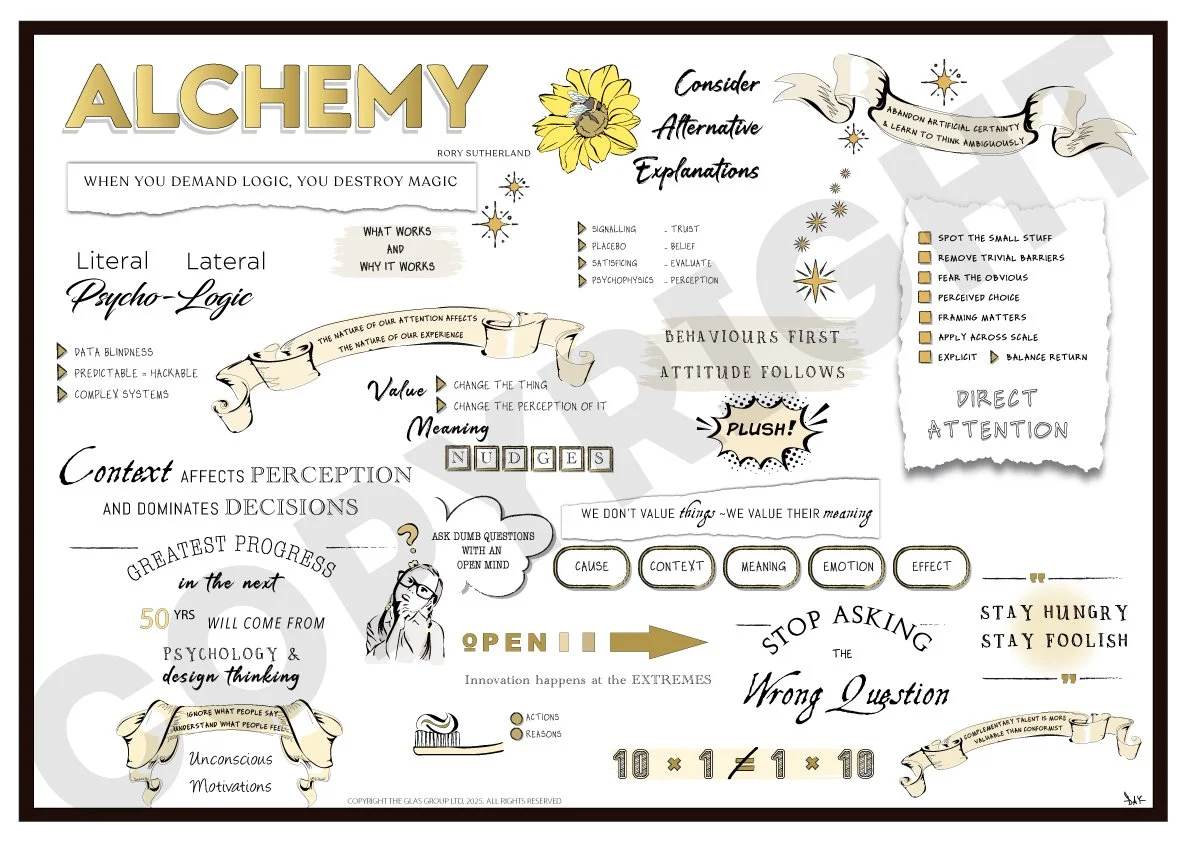
From a GLAS Method perspective, Alchemy challenges the drift toward reductionist thinking that privileges optimisation at the expense of Purpose / Meaning, Emotions / Awareness, and Joy / Fulfilment. A purely analytical approach often disengages people from the psychological and relational elements that drive behaviour and satisfaction. Sutherland’s emphasis on human perception and context supports GLAS by reminding leaders to balance rational optimisation with an appreciation for nuance, emotion, and human complexity — preserving alignment across elements that are easy to overlook when leaders operate solely in logic‑driven modes.
Alchemy also reinforces the importance of Environment / Context within the GLAS framework. The book shows that small changes in framing, context, or perception can massively alter outcomes, suggesting that leaders should design environments that shape behaviour in subtle but powerful ways rather than relying on force or linear incentives. This aligns with GLAS’s focus on creating conditions that sustain balance and coherence across the system, rather than treating symptoms with blunt, optimisation‑only tools.
Practically, the mindset encouraged by Alchemy functions as a creative LEAPS enhancer: leaders who challenge assumptions and reframe problems are better positioned to notice hidden opportunities (notice), question conventional paths (evaluate), generate innovative pivots (adapt), act with imagination (perform), and integrate new perspectives into future practice (sustain). By blending intuition, behavioural insight, and strategic experimentation, Alchemy supports GLAS’s broader mission of advancing holistic leadership that honours both human complexity and meaningful impact.
-
-