 Image 1 of 1
Leadership and Self-Deception (Arbinger Institute) Visual Synopsis by Dani Saveker
£4.00
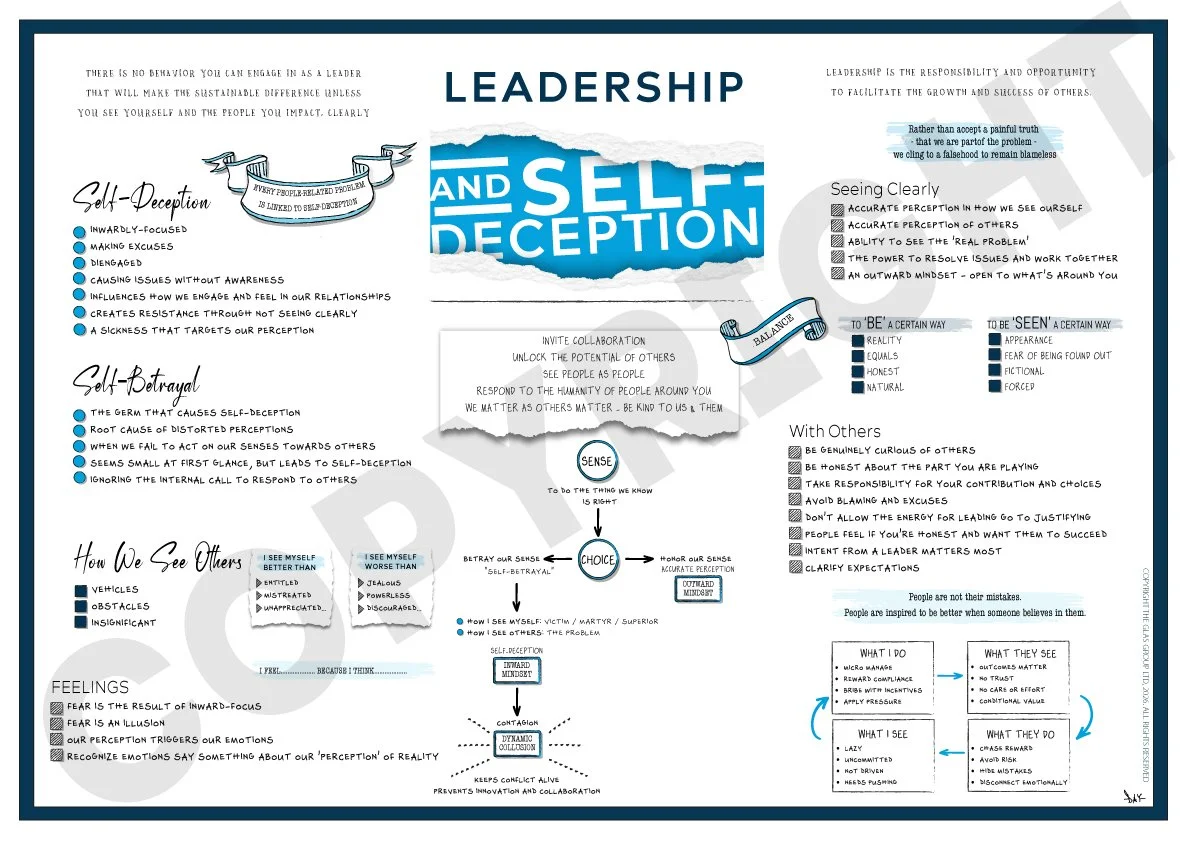
Leadership often breaks down not because of poor intent, weak capability, or lack of effort, but because leaders misread the people and situations in front of them. Leadership and Self-Deception describes this as being “in the box”, a state where leaders justify themselves, narrow their perception, and begin reacting to distorted versions of reality. Once in this state, behaviour appears to confirm their beliefs, control increases, trust erodes, and the system quietly deteriorates.
The GLAS Method® provides a complementary lens. Rather than focusing on blame or behaviour change, GLAS helps leaders see how balance and strain across seven interconnected elements shape perception, response, and impact. Self-deception rarely sits in one place. It shows up as a defensive Identity, strained relationships, overactivity, depleted energy, narrowed purpose, and a shift from influence to control.
Together, these perspectives reveal leadership as a living system rather than a set of techniques. When leaders fall into self-deception, they do not simply make poorer decisions, they alter the conditions around them. Others respond to what they experience, not to the leader’s intention, reinforcing the very behaviours the leader is trying to prevent.
Both approaches point to the same insight. Change does not begin with fixing people or forcing performance. It begins with restoring clear perception. When leaders step out of self-deception and notice how their internal balance is shaping the system, clarity returns, responsibility is shared, and influence replaces control.
Leadership improves not through harder effort, but through seeing differently first.
The download file you will receive does not have a watermark.
Click here to buy the book today at Amazon (.co.uk)
Click here to buy the book today at Amazon (.com)
Click here to find out more about the author
Leadership often breaks down not because of poor intent, weak capability, or lack of effort, but because leaders misread the people and situations in front of them. Leadership and Self-Deception describes this as being “in the box”, a state where leaders justify themselves, narrow their perception, and begin reacting to distorted versions of reality. Once in this state, behaviour appears to confirm their beliefs, control increases, trust erodes, and the system quietly deteriorates.
The GLAS Method® provides a complementary lens. Rather than focusing on blame or behaviour change, GLAS helps leaders see how balance and strain across seven interconnected elements shape perception, response, and impact. Self-deception rarely sits in one place. It shows up as a defensive Identity, strained relationships, overactivity, depleted energy, narrowed purpose, and a shift from influence to control.
Together, these perspectives reveal leadership as a living system rather than a set of techniques. When leaders fall into self-deception, they do not simply make poorer decisions, they alter the conditions around them. Others respond to what they experience, not to the leader’s intention, reinforcing the very behaviours the leader is trying to prevent.
Both approaches point to the same insight. Change does not begin with fixing people or forcing performance. It begins with restoring clear perception. When leaders step out of self-deception and notice how their internal balance is shaping the system, clarity returns, responsibility is shared, and influence replaces control.
Leadership improves not through harder effort, but through seeing differently first.
The download file you will receive does not have a watermark.
Click here to buy the book today at Amazon (.co.uk)
Click here to buy the book today at Amazon (.com)
Click here to find out more about the author