
Five Belief Aspects | Recalibrate | Carry On Warrior

Hello there! Welcome to my weekly LEAPS.
You’re receiving this email because you subscribed to my weekly Wednesday feature or our mailing list. Every Wednesday, I share 5 things using our LEAPS approach:
Learn: something new or an idea
Energy: an energy (good or bad) word and it’s meaning
Action: something to do
Processing: a question to consider
Shout out: something or someone that I want to celebrate or acknowledge

LEARN
Something Worth Sharing
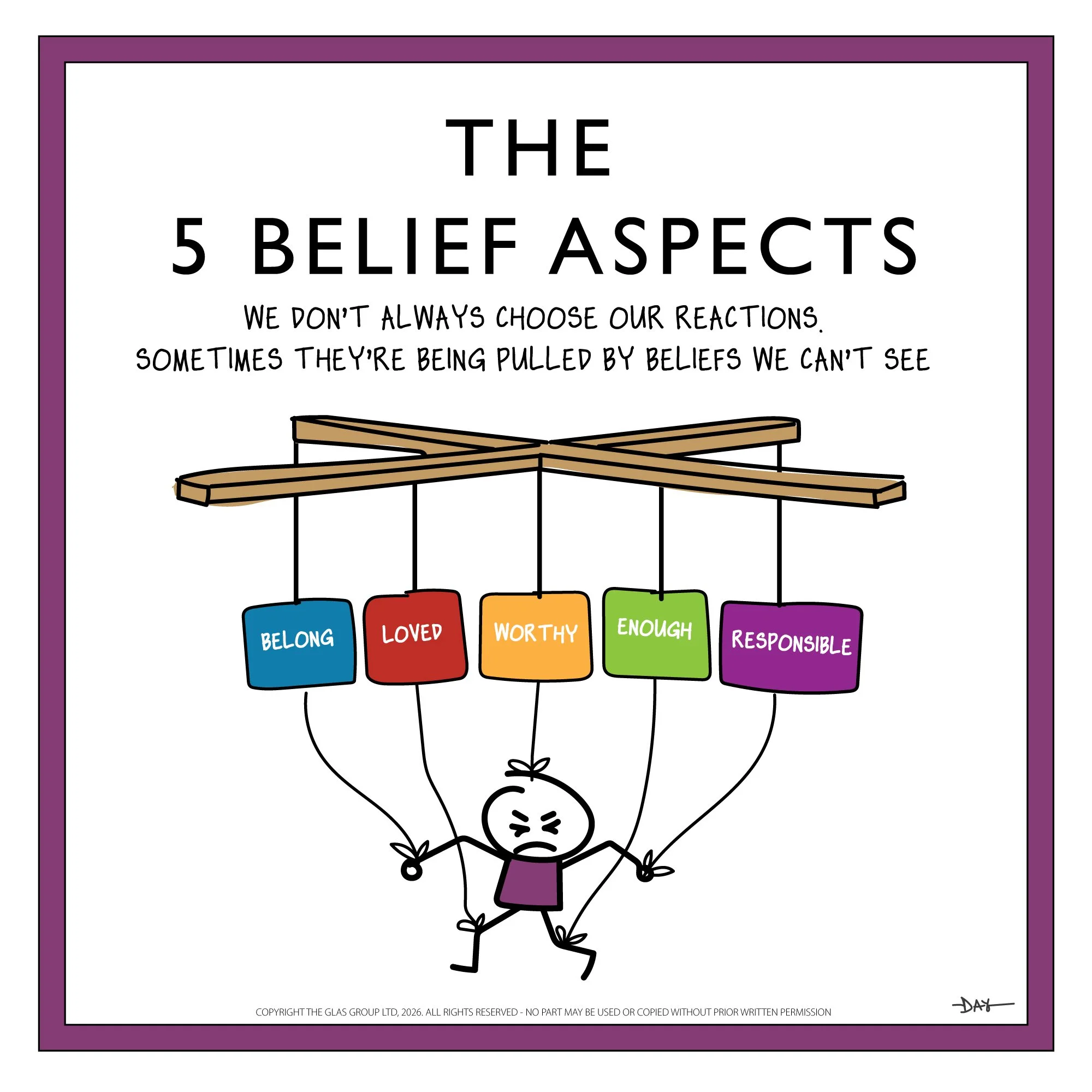
The Five Belief Aspects
Over many years of research and working with leaders, families and teams, I've noticed something remarkable: whatever challenge someone brings into the room, however complex the situation appears, I almost always find the same five belief aspects sitting quietly underneath.
These aren't personality traits.
They aren't values.
They aren't behaviours.
They are the foundational aspects of our identity that shape how we think, feel, decide and relate to others. Every one of us carries them, they are:
Belonging – Do I have a place?
Love – Am I loved and accepted?
Worthiness – Do I matter?
Good Enough – Am I enough?
Responsibility – What is mine to carry?
These belief aspects form part of our most basic human survival system. They help us make sense of the world and protect what matters most to us.
The problem isn't that we have these beliefs. The problem is when they become unbalanced.
When they are balanced, they provide a quiet confidence. We feel secure in ourselves and are able to think clearly, build healthy relationships and make better decisions.
When they become underdeveloped, we may feel rejected, unloved, unworthy, not good enough or powerless.
When they become overdeveloped, we often overcompensate. We seek approval, become perfectionists, take responsibility for everything, become controlling, defensive or even arrogant. Although these behaviours look very different, they are often attempts to protect the very same belief aspects.
Perhaps the most important insight is this: we are constantly searching for evidence that confirms our beliefs.
If our belief aspects are balanced, we naturally notice evidence that supports confidence, connection and possibility. If they are unbalanced, we unconsciously search for evidence that confirms our fears. A delayed reply becomes proof we don't matter. Constructive feedback becomes proof we're not good enough. Someone else's success becomes proof we're less worthy. A disagreement becomes proof we don't belong.
The event isn't creating the belief, it is triggering the belief that already exists. This awareness gives us an extraordinary opportunity. When something happens, instead of reacting immediately, we can pause and ask:
Which belief aspect has just been triggered?
Then ask:
Is it balanced, underdeveloped or overdeveloped?
That simple pause changes everything.
It allows us to move from unconscious reaction to conscious response. Instead of allowing an unbalanced belief to drive our behaviour, we can recognise it, recalibrate it and return to balance. This is why understanding the Five Belief Aspects is so important.
They don't just explain why we think and behave the way we do. They give us a practical way to understand ourselves, strengthen our relationships and make wiser decisions - because the trigger is rarely the trigger. More often than not, it's one of our Five Belief Aspects asking for our attention.
ENERGY
Focusing on an emotion or energy; a stand-out word / s
Recalibrate
We use this word a great deal in GLAS. The word is made up of two parts: Re- (Latin) meaning again, back, or anew + Calibrate from the French calibre ("diameter of a tube" or "standard size"), which comes from the Arabic qālib (قالب), meaning mould, pattern or template.
Over time, calibrate came to mean adjusting an instrument so it measures accurately against a known standard. So, to recalibrate literally means:
To return something to its correct standard by adjusting it again.
That's why it's such a powerful word for GLAS; you're not fixing something that's broken. You're not becoming someone different. You're returning yourself to your intended balance after life has gradually shifted you away from it.
ACTION
Something small that you can do that might make a big difference
The Recalibration Pause
The next time you find yourself feeling frustrated, defensive, anxious or emotionally triggered, don't react immediately. Instead, take a RECAP.
The RECAP process creates a Recalibration Pause, helping you recognise what is happening beneath the surface before choosing how to respond.
R – Recognise
What happened?E – Explore
Which of the Five Belief Aspects has been triggered?C – Check
Is it under-balaned, balanced or over-balanced?A – Adjust
What would move you back towards balance?P – Proceed
Respond and act from a place of balance.
PROCESSING
A question to think about and consider (you can discuss this with someone or write your thoughts down)
“In what ways have I tended to respond to triggers in the past? Why do I think I respond in this way?”
Our responses are rarely driven by the situation itself. More often, they are shaped by our previous experiences, learned patterns and the meaning we unconsciously attach to what has happened. Consider what your response might have been trying to protect, prove or avoid, and which of your Five Belief Aspects may have been activated.
This question will be added to the Community Space in the Leapers Club for you to share your thoughts.
SHOUT OUT
Who / what I think deserves recognition, my gratitude or to be celebrated.
Breaking Bread
One of the oldest ways humans have built trust and connection is by breaking bread together.
There is something different about a dinner table. The conversation slows. Stories are shared. People laugh, listen and reveal parts of themselves that rarely surface in a boardroom. Business meetings often focus on decisions. Dinner tables create understanding.
This week, I’m shouting out being able to share a meal with someone. Whether it's family, friends, colleagues or a client, there’s something beautiful about putting any the agendas aside and simply enjoying the conversation.
Are You Busy or Effective?
WHEN: Thursday 24th September
TIME: 12noon (BST)CLICK TO REGISTER
BONUS GIFT FOR YOU
This week’s little extra for you - from me.
This week’s gift is the updated visual for Carry On Warrior by Glennon Doyle.
This is available to you for free (for 7 days) using the code: OPENHEART when you check out. Access is via the link / button below.
Please note that if you miss the 7 day offer, we can not extend this for you. You can, however always access the download for a nominal charge.
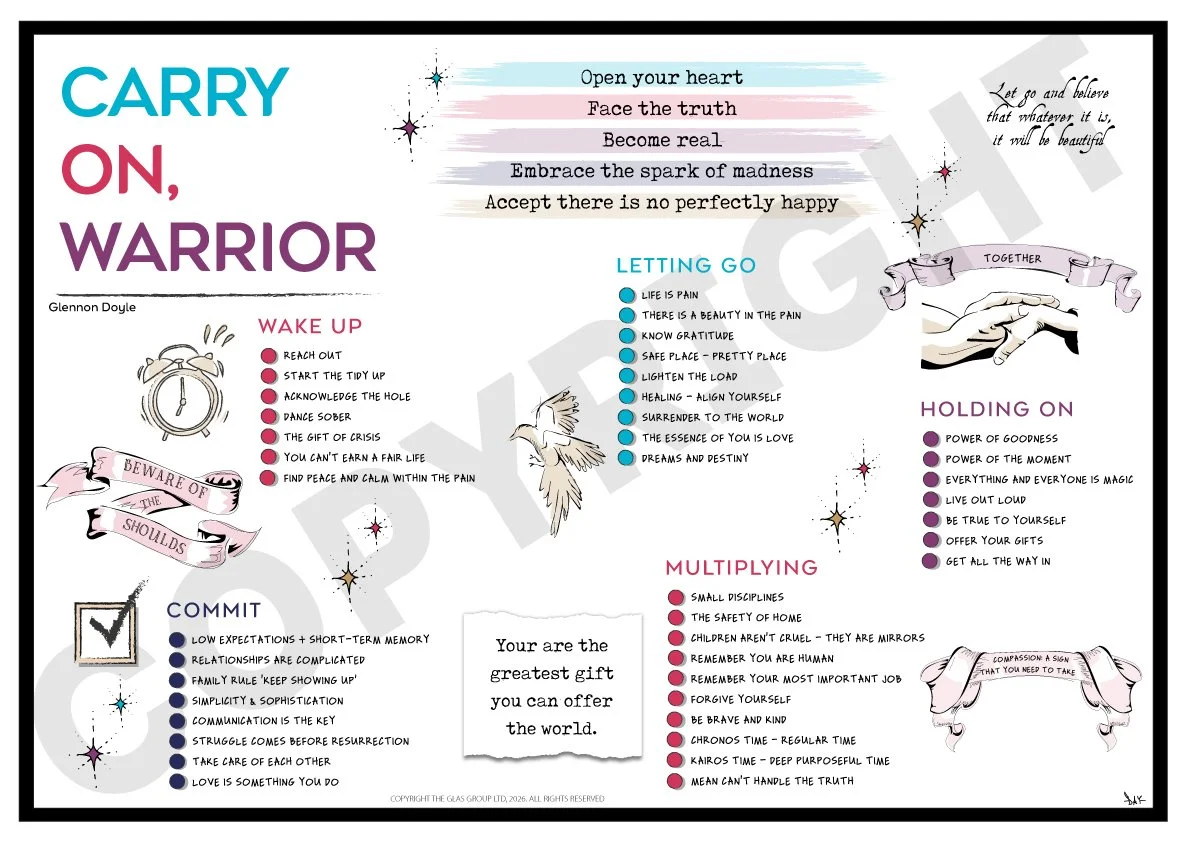
The artwork featured in this section is all copyrighted and for private use only. If you wish to use these online, in blogs / features or in presentations etc - we are happy to discuss licences. Please get in touch. The downloads do not have watermarks.
If you’d like to discuss having your ideas, business or culture captured visually - you can also let me know via email.
Join The Leapers Club
A clear starting point for learning the GLAS Method and understanding the wider framework
A private community space
Dedicated chat areas for focused conversations
Curated non-fiction book recommendations
Themed 90 day self-led Sets with online and downloadable Playbooks
L.E.A.P.S spaces to share your Learn, Energy word, Action, Processing, and Shout Out
Specialist sector Sets for teachers, family businesses, leadership development, and professional advisers (with many more to follow)
Check in quizzes to deepen reflection
Live and recorded events
Practical visuals and tools you can use immediately
Once a member, you have life-time community access
New: Free Family Business Scorecard
A simple way to identify where balance exists, where pressure may be building, and where conversations may be needed across a family business.
Complete the quick scorecard and receive a personalised PDF report.

LEAPS is a process used by our team and clients all the time - and even my own family on a daily basis.
I’ll be sharing a set of LEAPS each week with you and encourage you to do your own version:
L: what have you learned?
E: what’s your energy / feeling word
A: what’s one thing you need to do?
P: what are you thinking / processing?
S: who or what can you shout out?
